Two weeks in Antalya. Two missing words.
COP31 closed without an overarching climate deal. Ireland’s environment minister Darragh O’Brien said the EU could not back a text that left out fossil fuels and the transition away from them. The draft called for faster carbon removal while leaving the source of the problem unnamed. Developing countries also challenged the finance on offer. A separate decision on a just transition did pass.
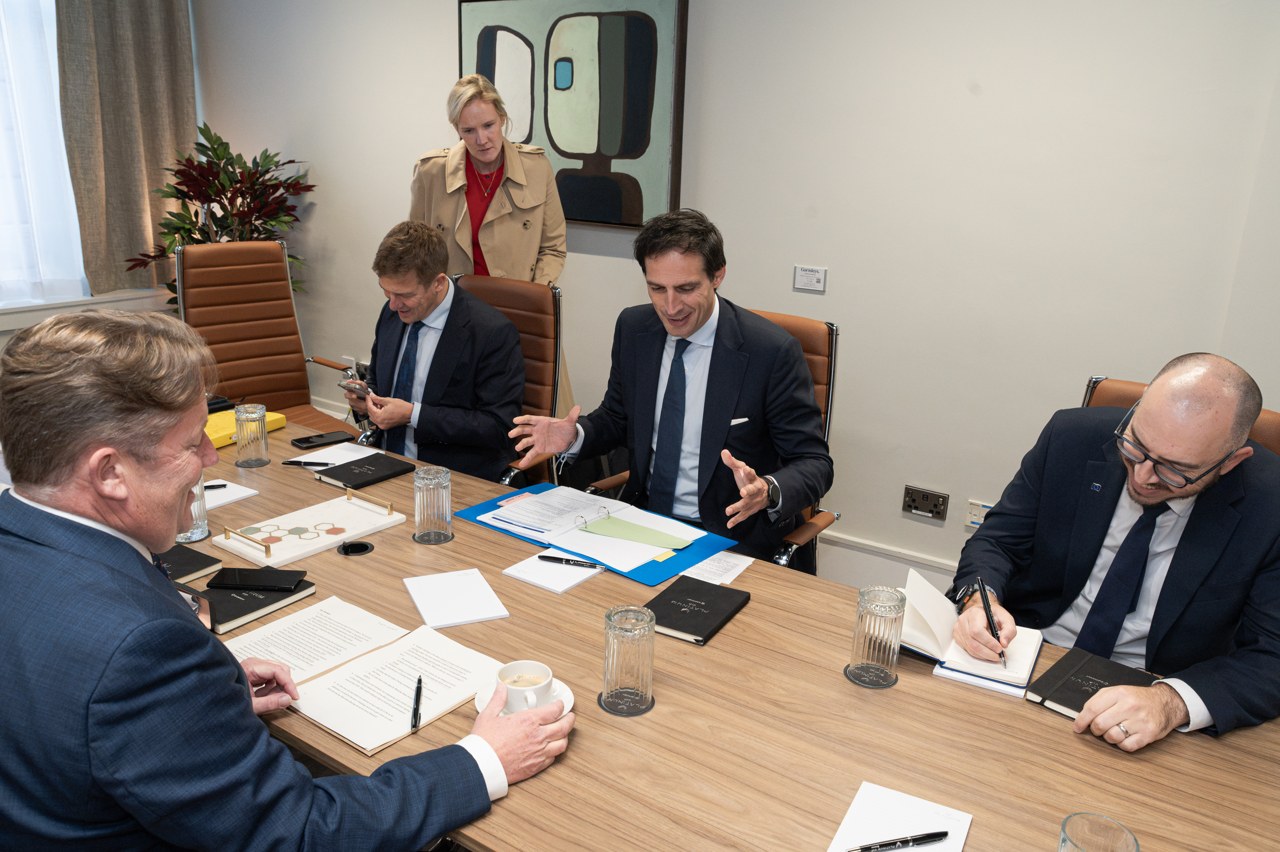
See the Guardian’s account from Antalya and Khalil Hamra’s photograph for AP of O’Brien and Hoekstra outside the plenary.
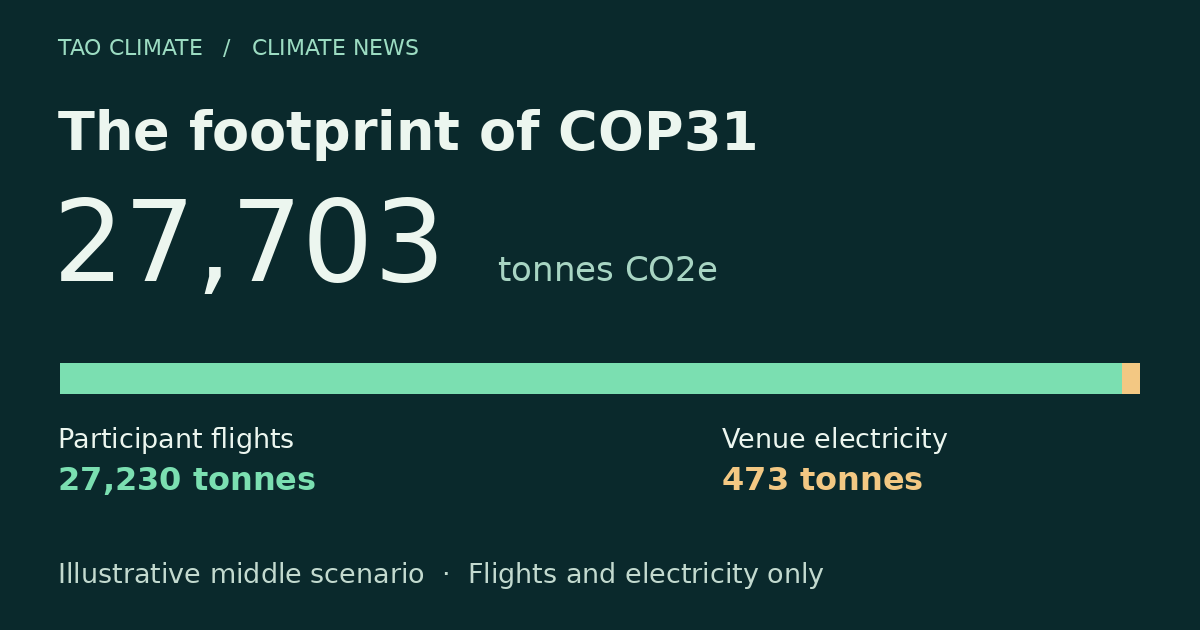
What did it cost the atmosphere to get everyone there? We estimate roughly 28,000 tonnes CO2e for participant flights and venue electricity in an illustrative middle scenario. About 27,200 tonnes come from flying and 470 from electricity. The UN’s provisional list counted 92,934 in-person registrations. How many actually flew, where they started and how much power the venue drew are still open questions.
See the calculation, assumptions and sources
We modelled return journeys for all participant groups, including observers, press and staff. The three scenarios use 35,000, 50,000 or 65,000 people flying an average of 5,000, 7,000 or 9,000 km return respectively. Distances represent kilometres flown, including connections. These are round-number assumptions to show sensitivity, not measured itineraries or statistical bounds.
For flights we applied the UK’s 2026 mixed-cabin international proxy of 0.0778 kg CO2e per passenger-km. The middle case gives 50,000 × 7,000 × 0.0778 ÷ 1,000 = 27,230 tonnes CO2e. Actual routes, aircraft and cabin mix would change the result.
For venue electricity we assumed 1, 3 or 5 MW of average grid demand across 14 days (336 hours). The middle case uses 1,008 MWh, close in scale to the UK’s early estimate of 900 MWh for Glasgow COP26, which also covered set-up and dismantling. At Türkiye’s published distribution-grid factor of 0.469 tonnes CO2e/MWh, the middle case gives 473 tonnes. Meter readings and on-site generation would improve it.
Combined flight and electricity scenarios give about 13,800, 27,700 or 46,300 tonnes CO2e. A separate UK-recommended adjustment for aviation’s non-CO2 warming effects adds around 18,900 tonnes CO2e-equivalent in the middle case (0.7 × 0.0772 kg CO2 per passenger-km). That gives a broader climate-impact estimate of about 46,600 tonnes equivalent, with considerable uncertainty.
Outside this subtotal are hotels, food, freight, venue construction, road travel, generator fuel and upstream fuel production. Dedicated private flights would need their own aircraft data. We found no audited COP31 total or venue meter readings for this estimate.
UN closing remarks · Reuters on Ireland and the EU · UN registration list · UK flight factors · Türkiye’s grid factors · Glasgow power benchmark
At Tao Climate we want businesses to cut fossil emissions and be able to show where removed carbon goes. Start with one flight, or explore how satellite observations and project records help trace hemp from field to building. Explore the Planetary Health Platform.