Six days above 2°C. What happens to the carbon in a field?
From 19 to 24 November, the air at Earth’s surface averaged more than 2°C above the 1850–1900 level on six successive days. We checked the Copernicus ERA5 daily record back to 1940. This is its first run of six. Monday 23 November set the record for the largest daily departure from the pre-industrial average, at +2.25°C.
The Paris Agreement aims to hold long-term warming well below 2°C and pursue efforts to limit it to 1.5°C. That takes decades of temperatures to assess. A run of six days tells us something different. It shows how high daily temperatures can already climb when a strong El Niño adds to the warming caused by greenhouse gas emissions.
The week in six readings
| November 2026 | Temperature difference |
|---|---|
| Thursday 19 | +2.06°C |
| Friday 20 | +2.13°C |
| Saturday 21 | +2.17°C |
| Sunday 22 | +2.23°C |
| Monday 23 | +2.25°C |
| Tuesday 24 | +2.20°C (preliminary) |
Follow the heat across the Pacific
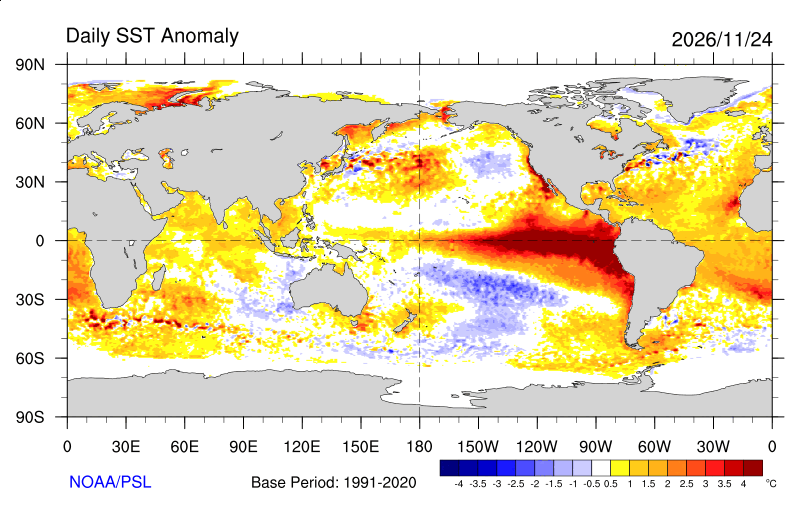
Find Ecuador on the west coast of South America and follow the equator west. That long red band is the ocean signature of El Niño. A warmer tropical Pacific gives up heat to the atmosphere and shifts where rain falls. In November, NOAA reported enhanced rainfall over the central and eastern Pacific and suppressed rainfall over Indonesia. Its forecasters expect a strong to very strong El Niño to remain likely into early 2027.
When a forest takes up less CO2
Hotter, drier conditions in parts of the tropics can slow plant growth and increase fire risk. People face immediate consequences through smoke, water shortages and crop losses. There is also a consequence for all of us. When vegetation takes up less carbon, a larger share of what we emit stays in the air.
The UK Met Office put a number on that effect. With El Niño included, its forecast puts the 2027 increase in annual average atmospheric CO2 at Mauna Loa in Hawaii at 3.51 parts per million. With the El Niño sea-temperature changes taken out of the model, the estimated rise was 2.57. In both cases, human emissions keep pushing the concentration upwards.
What a carbon buyer should ask after a dry season
A grower can plant the same area of hemp two years running and harvest different amounts. A buyer financing carbon removal needs to know what grew, what was harvested and where the carbon went. In our Ukrainian housing project, that trail runs from a field to hemp used in a wall. Satellites can show changes in vegetation. Harvest weights and material records tell us how much entered the building. Estimating net removal also means accounting for processing and transport emissions and how long the carbon will stay stored.
Cutting fossil fuel use reduces the flow of CO2 into the atmosphere. For emissions that remain, businesses need removals they can substantiate, especially when a growing season goes differently from plan. Follow the evidence from field to building in Ukraine, or see the latest Pacific map on Weather AI.